
Partnering with the health sector in Austria
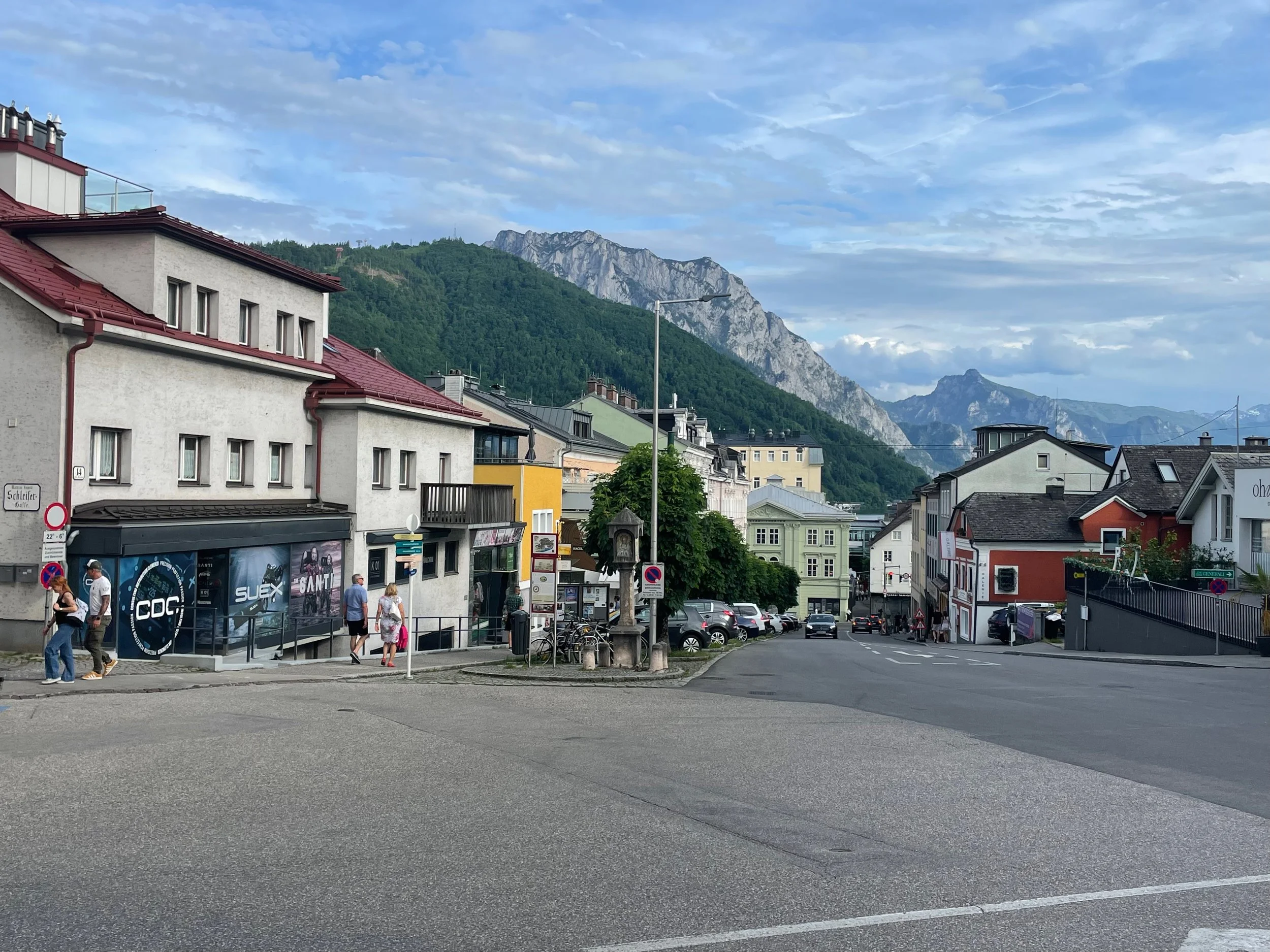
Across Austria there are 11 projects underway to apply the Healthy Streets Approach in small towns, villages, suburbs and cities.
This initiative is funded and coordinated by the Austrian Health Promotion Fund / Austrian National Public Health Institute.
Eleven projects are currently being implemented in four Austrian provinces. The cities of Vienna (1 project), Graz (4 projects), Linz (1 project), Gmunden (1 project), Tulln (1 project), Gleinstätten (1 project), Brunn am Gebirge (1 project) and Pischelsdorf am Engelsbach (1 project) are participating.
How this programme started
In 2024, the Austrian Health Promotion Fund published the project call ‘Gesund unterwegs’ (Healthy Mobility) Active Mobility and Healthy Streets to initiate pilot projects on the Healthy Streets approach in Austrian cities and municipalities.
These projects are focussed on testing new methods for engaging local communities and piloting modest changes to streets to deliver Healthy Streets outcomes.
All the projects had to include:
improving the Healthy Streets Indicators,
initiation of a process in the municipality/city,
cross-sectoral work,
involvement of the population,
use of the Healthy Streets qualitative assessment.
The 11 projects started in May-July 2025 with a combined budget of over €1.6 million and will be completed by the end of 2028.
To support the project teams we developed a suite of bespoke resources.
Qualitative Assessment tool – First we translated the Healthy Streets Qualitative Assessment tool into German. This tool is very useful throughout the project process from initial scoping onwards to ensure all relevant aspects of the Healthy Streets Indicators are being considered.
Quantitative Community Survey tool – We translated the Qualitative Assessment tool into a digital survey tool that the project groups can use to gather quantitative insights from members of their community
Online training videos – We produced a series of five videos to support each of the project teams getting to grips with the Healthy Streets Approach and how to apply it in their project. (link to the youtube video)
Tutorials – Based on the training videos, representatives from all projects took part in three online tutorials that expanded on the content of the videos. This enabled projects to share experiences and exchange ideas on the topics discussed and Lucy Saunders offered advice drawing from global experience.
Networking meetings – Organising annual face-to-face networking meetings enables the exchange of experiences between projects, encourages mutual learning and builds a community.
What happens next
In 2026 we will be taking a study visit to Budapest to meet the project teams implementing Healthy Streets transformation projects there (link to the Budapest site)
Alongside the respective project evaluations, the University of Natural Resources and Life Sciences will conduct a comprehensive evaluation. This evaluation will examine the applicability of and satisfaction with the Healthy Streets Approach in the municipalities. They will identify the factors that were necessary for successful implementation, the obstacles to achieving the objectives and how to ensure the sustainable continuation of the Healthy Streets Approach beyond the end of the project.
Deep dive into the Gmunden Project
Progress so far
The project aims to make the street space “Am Graben” in the City of Gmunden more attractive for people travelling through on foot or by cycle and those dwelling in the space. Currently this city-centre street is traffic dominated making it feel unsafe, uncomfortable to socialise in and to walk and cycle through for many people.
Since April 2025 the core project team have been meeting regularly to coordinate the actions. This group includes the project manager from the city administration, a mobility consultant, a landscape architect who is fully accredited as a Healthy Streets Practitioner and Designer and 3 members of the city administrations’ mobility committee.
In May and June approximately 80 households/businesses with an address on Am Graben were invited to a 45 minute interview. This was an open conversation around the Healthy Streets Approach asking participants their opinions about potential needs of other users, aspects of the street that are most stressful and most positive. These interviews were transcribed an analysed.
In July 2025 an intersectoral focus group was convened comprising of:
Political representatives: Mayor & Deputy Mayor, councillors for social affairs and health, mobility and construction, climate protection
Administration: departments road construction and commerce
Representative of Upper Austria Transport Authority
Core project team
In September 2025, over 2 days individuals walking along Am Gmunden were invited by interviewers to do a quantitative Healthy Streets Assessment either on paper, tablet or phone. This was promoted in advance with poster stands, digital screens in and outside tramways, social media, municipality newspaper, local newspaper, poster campaign.
In October and November 2025 this data was used to develop proposals for short and medium term changes to the street which were discussed first with the core project group. Then in December 2025 a participatory workshop in the city theatre that fronts onto Am Graben was held.
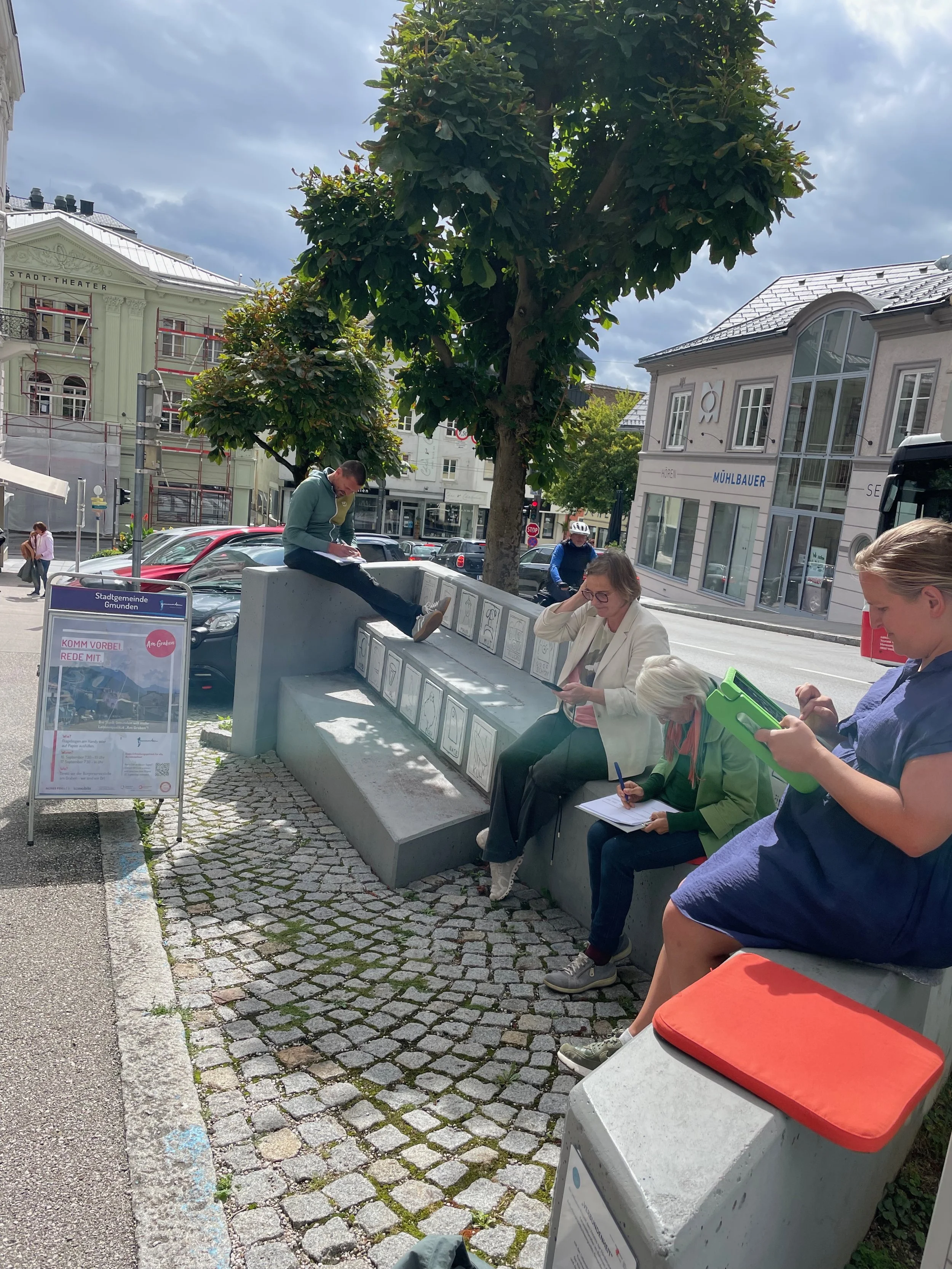
Community members in Gmunden share their views on the street using the survey tool
A staged approch to implementation
Implementation starts in spring 2026 with short-term measures:
The speed limit will be reduced from 50km/h to 30km/h
The zebra crossing will be repainted
The on-street parking period will be shortened from 90 minutes to 60 minutes
The existing delivery zone will be adapted to make it easier for vans to use
A new temporary crossing with a ‘refuge island’ will be added to review the best location for it
The footpath will be widened at the side street entrance to help people who want to cross the street to make eye-contact with people driving cars.
Curbs will be lowered on both sides of the street to make it easy crossing
The next stage of the project will be to…
build the permanent crossing
construct a pedestrian island
re-lay the pavements to make them level
add trees and planting
add a bench and cycle stands
install a new delivery zone to prioritise deliveries to businesses over private cars
parking spaces will be fitted with wheel stoppers prevent parked cars encroaching on the limited footpath space.
In the longer term a new square will be created to create a meeting a resting place.